USDA’s September 11, 2026 Crop Production report confirmed what wholesale rice buyers have been watching build all season. US rice supply for 2026 is the tightest it’s been in years. It also came in below USDA’s own spring forecast.
For a procurement manager locking in Q4 and 2027 contracts, that’s not a footnote. It changes how much weight to put on price forecasts. It changes how far ahead to commit volume. And it changes how much a reliable, USDA-graded domestic source is worth right now.
⚡ Executive Summary: What the September Report Means for Buyers
USDA’s newest numbers confirm 2026 US rice production fell sharply. The causes point to a squeeze that outlasts this one report.
- The Headline Number: US rice production is estimated at 158.18 million cwt for 2026, down 23.5% from last season. That’s well below USDA’s own 175.2 million cwt forecast from three months earlier.
- The Acreage Drop: Harvested acreage fell to 2.057 million acres, down 24.9% year-over-year; planted acreage is down a comparable 25.2%.
- The Yield Offset: Yield rose 1.9% to 7,690 pounds per acre. That’s the only reason production didn’t fall by the full margin of the acreage loss.
- Why It’s Happening: USDA’s Economic Research Service cites low prior-season prices and high input costs.
- Where Price Is Headed: Long-grain farm prices bottomed at $10.40 per hundredweight in 2025/26. USDA now forecasts a climb to $12.00 per cwt for 2026/27 — the first recovery in two years.
- The Buyer Takeaway: Tighter domestic supply and a turning price trend both argue for locking in volume now. An established, USDA-graded supplier beats sourcing spot in this market.
TL;DR: Tighter production and a rising price forecast argue for locking in 2027 volume now, not sourcing spot.
The September 2026 Numbers, By the Acre
USDA’s National Agricultural Statistics Service (NASS) released its September Crop Production report on September 11, 2026. It’s a survey-based estimate of the actual 2026 crop. That’s different from the trend-based forecasts USDA’s World Agricultural Outlook Board was publishing back in the spring. See our rice marketing year guide for the full reporting calendar.
It landed well below those earlier numbers. June’s WASDE had total rice production at 175.2 million cwt for 2026/27. September’s survey data puts it at 158.18 million cwt.
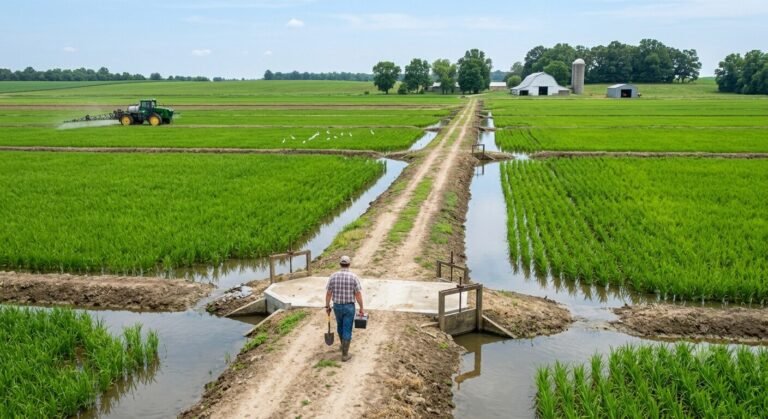
Nationally, growers planted 2.102 million acres of rice in 2026 and harvested 2.057 million. Both are down roughly a quarter from 2025. Yield held up, rising 1.9% to 7,690 pounds per acre. That kept production from falling by the full margin of the acreage loss.
Why US Rice Acreage Keeps Shrinking
The decline didn’t start with this report. We flagged the shift in our April rice crop report, when early estimates pointed to roughly 22% fewer planted acres. USDA’s Economic Research Service confirmed the trend in June. It forecast 2026/27 long-grain production at 122.5 million cwt, down 20% from the year before. That’s the lowest total since 2011/12. ERS attributed the drop to “reduced year over year harvested acreage amid sustained low prices and relatively high input costs.”
In plain terms: growers came off a weak 2025/26 price year. Facing higher costs to plant, they moved acres elsewhere rather than replant rice. That’s a structural pullback, not a one-season blip. It’s why this month’s actual survey number landed below the spring forecast instead of above it.
What It Means for Price
USDA’s season-average farm price for long-grain rice fell from $14.00 per cwt in 2024/25 to $10.40 in 2025/26. That drop is what pulled acres out of production in the first place. For 2026/27, USDA is forecasting a recovery to $12.00 per cwt. All-rice prices show the same pattern: $15.10, then $12.50, now forecast at $13.50.
That’s not a return to 2024 levels. But it is the first upward revision in the cycle, and it’s happening as supply contracts. For buyers who’ve been sourcing against a falling price curve, that curve has turned.
What This Means for Your Sourcing Plan
A tighter, USDA-graded domestic crop with a turning price trend changes the math on sourcing. Locking in a supplier relationship now pays off over sourcing spot as needed. We supply USA-grown long-grain and parboiled rice to foodservice distributors and export buyers. Every shipment is sourced from the traditional US rice belt and graded to USDA standard.
FAQ: US Rice Supply in 2026
Is the US facing a rice shortage in 2026?
Not in the traditional sense of empty inventory. This is a production decline driven by fewer planted acres, not a supply failure. Tighter production means less cushion in the system. And it means firmer prices than buyers have seen the past two seasons.
Why did US rice acreage fall so much in 2026?
USDA’s Economic Research Service points to two factors: sustained low prices in the prior marketing year, and high input costs. Together, they pulled acreage out of rice ahead of spring planting.
Will rice prices keep rising into 2026/27?
USDA’s current forecast has long-grain prices recovering to $12.00 per cwt for 2026/27, up from $10.40 the prior season. That’s a forecast, not a guarantee, but it lines up with the tighter supply confirmed in September’s report.
Where does F. Garcia source its rice?
From the established US rice belt, with every shipment USDA-graded. We supply long-grain and parboiled rice in pack sizes from 1 lb to 100 lb and super sacks. Foodservice distributors and export buyers are our core customers.
Locking In Rice Supply for 2026/27?
We supply USDA-graded, USA-grown long-grain and parboiled rice to foodservice distributors and export buyers. We also source USA jasmine, brown, and brown parboiled rice, on contract. Pack sizes run from 1 lb to 100 lb, plus super sacks. Send us your grade, volume, and destination, and we’ll quote against spec.