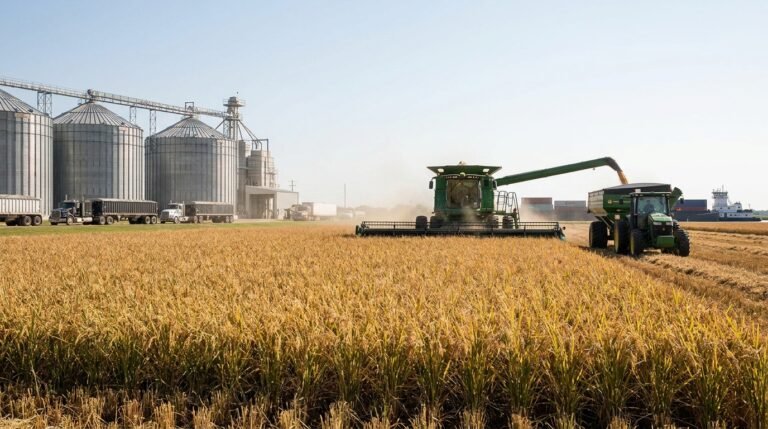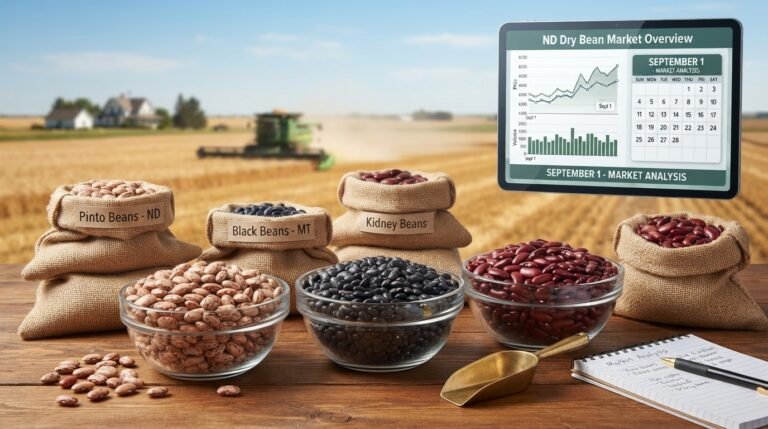
Harvest Update — September 27, 2026. Originally published May 21, 2026. This update replaces our spring projections with USDA’s June and August figures, current grower bids, and harvest-season crop conditions.
Sources: Every figure below is linked to USDA or another cited source. Revised October 2, 2026 to lead with the like-for-like acreage comparison, clarify how the price changes are calculated, and add a section on what could soften prices.
Focus Area: Wholesale Dry Beans | Regions: US (ND, MN, MI, NE, CO), Mexico (Chihuahua, Zacatecas, Durango)
In May we told procurement managers that the dry bean market 2026 was heading into a supply squeeze: fewer US acres, a vulnerable Mexican crop, and grower bids that had not yet priced either risk. Four months later, acreage, the Mexican crop, and grower bids all moved the way we expected. US plantings came in 15.6% below USDA’s final 2025 figure, the North Dakota crop has deteriorated through harvest, and USDA-reported grower bids have risen 50% for pinto beans and 69% for black beans since our May report.
⚡ Executive Summary: What Changed Between Planting and Harvest
Our spring warning on the dry bean market 2026 is now a harvest-season reality: less US supply, weaker crop conditions, and prices that have already moved.
- The Acreage: USDA puts 2026 US dry bean plantings at 1,153,000 acres, down 15.6% from the final 2025 figure of 1,366,000 acres (28% below USDA’s June 2025 in-season estimate of 1.60 million, which USDA later cut). North Dakota is down 22% against final 2025 (37% against the June 2025 estimate). It is the smallest planted area of any year since at least 2019.
- The Forecast: USDA’s August forecast of 23.3 million cwt is 13% below 2025 and the smallest crop since 2021.
- The Condition Slide: North Dakota dry beans rated good-to-excellent fell from 38% to 25% between early August and September 20, after USDA’s forecast was set.
- The Price Move: Since our May report, USDA AMS grower bids in ND/MN have risen 50% for pinto beans and 69% for black beans, roughly double year-ago levels.
- Mexico: Spring/summer bean planting is estimated at roughly 30% below 2025, and Chihuahua’s slow-darkening pinto crop, the Mexican bean that competes most directly with US pintos, is expected to fall by more than two-thirds.
Our May Call vs. the September Data
| Signal | What We Said in May | What the Data Shows Now |
|---|---|---|
| US acreage | Plantings falling as growers rotate to other crops | 1,153,000 acres, down 15.6% from the final 2025 figure and 28% below USDA’s June 2025 in-season estimate (USDA NASS, August) |
| US production | Lower crop, with downside if weather turned | 23.3 million cwt forecast, down 13%; ND conditions have weakened since |
| Mexico | El Niño a threat to the rain-fed crop | Planting estimated ~30% below 2025; drought losses reported in Zacatecas; Chihuahua pinto crop sharply lower |
| Grower bids | Bids near year-ago levels (black about 10% below, pinto about 4% above, per USDA’s May 12 report); lock in volume now | Up 50% (pinto) and 69% (black) since our report, using USDA’s reported averages; roughly double year-ago levels (USDA AMS) |
US Dry Bean Supply: The Smallest Planted Area Since at Least 2019
USDA’s August Crop Production report puts 2026 plantings at 1,153,000 acres. USDA’s final 2025 figure is 1,366,000 acres, so 2026 plantings are down 15.6% year over year.
A year earlier, USDA’s June 2025 Acreage report had put 2025 plantings at 1.60 million acres, and against that in-season estimate 2026 is down 28%. USDA later cut the 2025 figure, so the 28% overstates the year-over-year change; the 15.6% is the like-for-like comparison. Both use USDA’s own figures. Figures cover all dry edible beans, excluding chickpeas.
| USDA NASS | 2024 | 2025 | 2026 (Aug. forecast) |
|---|---|---|---|
| Planted acres, June estimate | 1,359,000 | 1,600,000 | 1,161,000 |
| Planted acres, latest | 1,540,000 | 1,366,000 | 1,153,000 |
| Harvested acres | 1,504,200 | 1,334,600 | 1,123,000 |
| Yield (lb/acre) | 2,081 | 2,012 | 2,079 |
| Production (cwt) | 31,306,000 | 26,855,000 | 23,347,000 |
The decline is concentrated in the main pinto-growing states. North Dakota planted 450,000 acres, down 22% from the final 2025 figure of 580,000 (37% below USDA’s June 2025 estimate of 710,000). Against the same June 2025 estimates, Colorado is down 48% and Nebraska 36%, while Minnesota (−19%) and Michigan (−13%) fell less.
The 2026 figures are still estimates too. USDA revises dry bean acreage in its October Crop Production report, and as 2025 showed, in-season figures can move by 15% or more.
Against 2024, planted area is down 25% and forecast production is down 25%. In pinto and black beans, 2025 had already fallen hard: pinto plantings dropped from 698,700 acres in 2024 to 545,600 in 2025, and black beans from 431,100 to 332,600.
Harvest Conditions: The Risk Is to the Downside
USDA’s August forecast assumed a yield of 2,079 lb/acre, above 2025. Conditions in the largest producing state have weakened since. According to NASS Crop Progress and Condition reports:
- North Dakota: 25% good-to-excellent as of September 20, down from 38% on August 9; 36% harvested.
- Minnesota: 65% good-to-excellent, down from 78% on August 9; 43% harvested.
- Michigan: 37% good-to-excellent; 19% harvested.
The US Drought Monitor for September 22 shows 63.7% of North Dakota in moderate drought or worse and 45.1% in severe drought or worse. Colorado and Idaho are running behind North Dakota. A lower condition rating does not settle final yield, but it does make the August number look more like a ceiling than a floor.
Dry Bean Prices: Grower Bids Near Double Year-Ago Levels
Since our May report, ND/MN grower bids have risen 50% for pinto beans and 69% for black beans. USDA AMS Daily Grower Bids for May 12, 2026 (archived copy) and September 25, 2026 and the Weekly Bean, Pea, and Lentil Market Review report US #1 food-grade beans, delivered warehouse, in $/cwt:
| Class / Region | May 12, 2026 (week of our report) | July 20, 2026 | September 25, 2026 | Year Ago (Sept. 25, 2025) |
|---|---|---|---|---|
| Pinto, Min-Dak (ND/MN) | $28.50 | $32.33 | $42.00–43.00 | $21.50 |
| Black, Min-Dak (ND/MN) | $25.67 | $29.33 | $40.00–45.00 | $22.00 |
| Black, Michigan | — | $28.00 | $42.00–45.00 (Sept. 21) | — |
| Navy, Min-Dak (ND/MN) | $28.00 | — | $38.00 | $28.00 |
The percentage changes use the averages USDA reports for each bid range ($42.75 pinto and $43.33 black as of October 2, versus $28.50 and $25.67 on May 12); the table shows the printed ranges. These are prices paid to growers at the warehouse, not delivered prices. They are a market benchmark: quotes also depend on grade, crop year, volume, lead time, and destination. Bids have risen more than 30% since mid-July alone.
Mexico: A Smaller Crop Where It Competes with US Pintos
The dry bean market 2026 has a Mexican half too: its spring/summer (PV) cycle is the country’s main rain-fed bean crop, and Chihuahua, Zacatecas, and Durango normally supply about 75% of it. In a September 23 Global Pulse Confederation Trade Talk interview (Pulse Pod, members only), Mexican bean trader Felipe Sandoval estimated PV planting at roughly 30% below last year, with yields also at risk from sporadic, uneven rainfall. Mexico’s official planting figures from SIAP are still pending. Sandoval’s numbers are one market participant’s estimates from a members-only interview, so treat them as market color rather than official data; SIAP’s figures will be the check.
For US buyers, the most important detail out of Mexico is Chihuahua. Its slow-darkening pinto is the Mexican bean closest in quality to US pintos, and Sandoval expects it to fall from as much as 100,000 metric tons in a normal year to under 30,000. In Zacatecas, the producer group Frijoleros Organizados por Zacatecas reported in late September that more than 125,000 hectares were affected by drought, with 45,000 hectares already declared total losses. NOAA’s Climate Prediction Center, in its September 10 ENSO discussion, gives a greater than 90% chance of a very strong El Niño through fall and winter 2026–27.
The exchange rate also favors US beans. The Federal Reserve puts the peso at about 17.2 per dollar in mid-September, against 18.7 a year earlier, so the same US price costs a Mexican buyer about 8% less in pesos.
What Could Slow the Mexico Pull
Mexican import demand will not necessarily arrive all at once. The Mexican government sold a large volume of stockpiled beans below market this year, around $470/MT for black and $500–520/MT for pinto according to the same interview, and much of that volume is being held rather than resold. Those stocks can delay import buying. Sandoval also cautioned that prices driven by supply alone risk outrunning what consumers will pay. How much of Mexico’s shortfall turns into US import demand, and when, is the biggest unknown left this season.
What Could Soften US Prices
Large carry-in stocks are the main reason supply-driven price spikes can fade. In its latest estimate, USDA ERS puts ending stocks for crop year 2025 at about 1.64 billion pounds of dry beans including chickpeas, essentially unchanged from 1.63 billion a year earlier, and ERS may revise it. Stocks are not published by bean class, so we cannot say how much of that sits in pinto and black beans, where the price move is concentrated. The ERS series includes chickpeas, so it is not directly comparable with the production figures above.
Other developments that could pull prices back: an October USDA revision that raises acreage, North Dakota yields holding up better than the condition ratings suggest, and demand softening if prices outrun what consumers will pay. Any of these would make a forward purchase made today look expensive in hindsight.
What the Dry Bean Market 2026 Means for Procurement Managers
1. Decide Timing Against Your Own Price Exposure
Bids have already moved, so the question now is how much price risk you want to carry. Covering Q4 and Q1 needs from new crop fixes a known cost; buying spot as you go keeps flexibility if prices fade, for the reasons above. Buyers with firm volume and thin margins for price swings have more reason to cover part of their need now. Buyers with flexible volume, or with limited storage, can reasonably wait for the October USDA revision. Either is defensible; size it to your exposure. With harvest under half complete in ND and MN, new-crop availability is still being established.
2. Write Your Spec Before You Write Your Order
A drought-stressed crop means more variation in size, color, and splits. Specify USDA grade, moisture, and crop year up front, and decide in advance whether you will accept 2025-crop inventory. Some dealers are already quoting 2025 and 2026 crop together.
3. Watch Three Reports
Two more reports will settle the dry bean market 2026 debate: USDA’s October Crop Production report will revise 2026 acreage, and its Crop Production Annual Summary in January gives the first official figures by bean class. In Mexico, SIAP’s official spring/summer planting and harvest figures will show how much import demand to expect. Our dry edible bean marketing year guide lays out the full USDA reporting calendar.
Frequently Asked Questions About the Dry Bean Market 2026
Is there a dry bean shortage in 2026?
Supply is tighter, not absent. USDA forecasts 2026 production at 23.3 million cwt, down 13% from 2025, and grower bids for pinto and black beans have roughly doubled from a year ago.
What is the price per pound of dry beans in the US in 2026?
As of September 25, 2026, USDA AMS reports ND/MN grower bids of $42–43/cwt for US #1 pinto beans, about 42–43 cents per pound at the warehouse. Bids are warehouse prices, not delivered prices, and quotes vary by grade, crop year, volume, lead time, and destination.
How much did US dry bean acreage fall in 2026?
USDA’s August estimate puts 2026 plantings at 1,153,000 acres, down 15.6% from USDA’s final 2025 figure of 1,366,000 acres and 25% from 2024. Against USDA’s June 2025 in-season estimate of 1.60 million acres, which was later revised, the decline looks like 28%.
When will USDA publish final 2026 figures for pinto and black beans?
USDA revises total dry bean acreage in its October Crop Production report. Class-level planted acreage and production appear in NASS’s Crop Production Annual Summary, released in January.
Leverage 52 Years of Market Intelligence
F. Garcia Wholesale & Export has supplied dry beans from Miami since 1974. We can supply USDA-graded pinto, black, navy, and small red beans to importers, distributors, and foodservice buyers, and we quote against the buyer’s spec. A clear spec protects you in any market, tight or loose.
- 📞 Call: (305) 863-8006 ext. 103
- ✉️ Email: info@fgarciafoodexport.com
- 📍 Visit: 9117 NW 105 Circle, Medley, FL 33178
Sourcing Pinto or Black Beans for Q4 and 2027?
We can supply USDA-graded US dry beans in 25, 50, and 100 lb bags and super sacks to buyers across the US, the Caribbean, Latin America, and Africa, with availability and crop year confirmed at quote. Send us the class, grade, volume, crop-year preference, and destination, and we will quote against your spec.
Cite this Report:
F. Garcia Wholesale & Export, Inc. (May 2026; updated September 2026). North American Dry Bean Market Intelligence: US Acreage and Mexico Harvest Analysis. Sources: USDA NASS (Acreage, Crop Production, Crop Progress), USDA AMS Market News, USDA ERS, US Drought Monitor, NOAA Climate Prediction Center, Federal Reserve H.10, and the Global Pulse Confederation.