⚡ Executive Summary: The U.S. rice marketing year is the reporting and trading calendar every rice trader, merchandiser, and wholesale buyer needs in order to read USDA and futures data correctly — and it doesn’t line up with the calendar year the way most people assume.
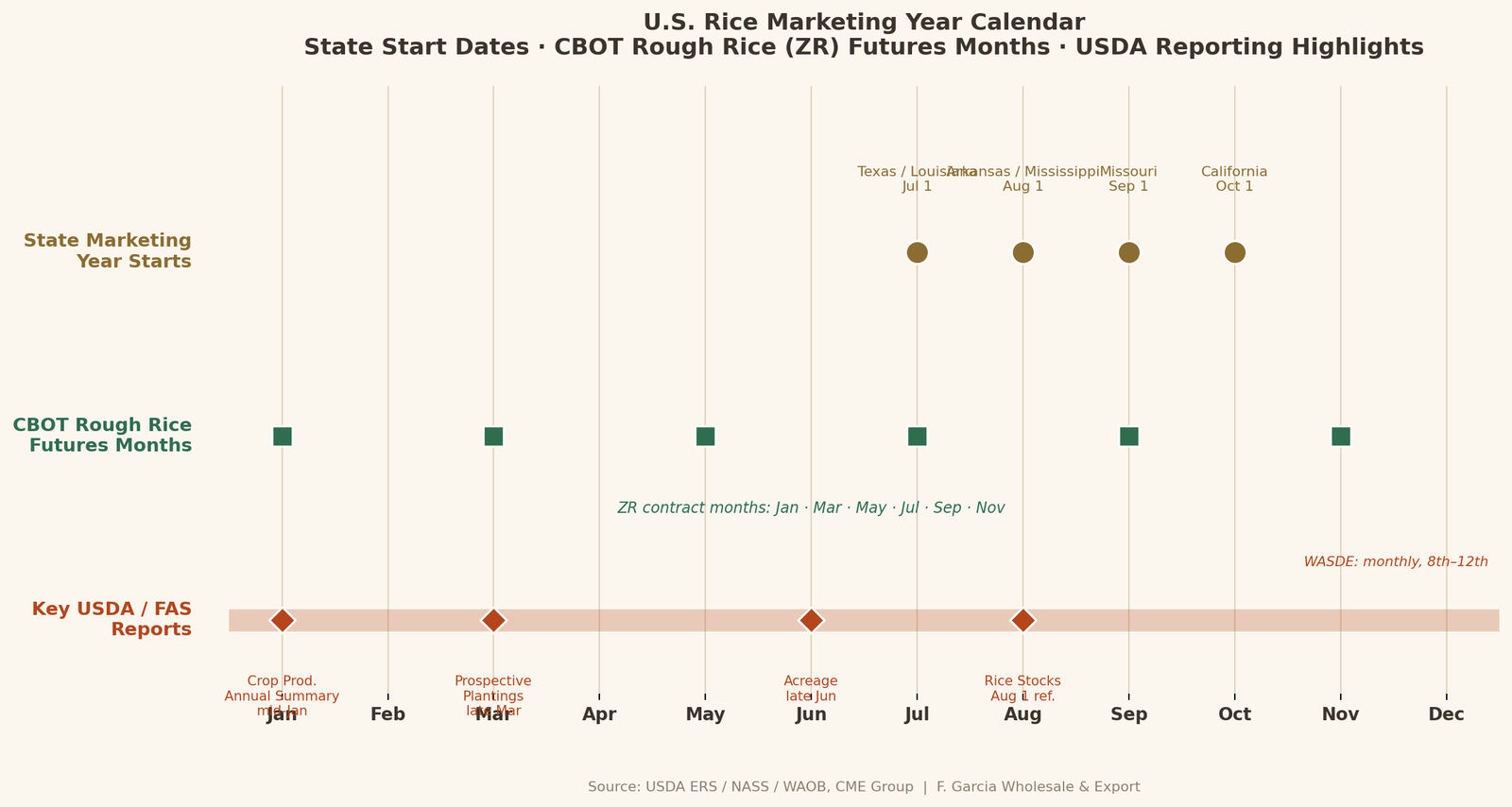
- The national rice marketing year runs from August 1 to July 31. However, individual producing states follow their own local marketing years, which is a crucial distinction when reading USDA data.
- The USDA publishes rice-specific data on a predictable annual cycle. For example, releases include Prospective Plantings (March) and Acreage (June). Additionally, they issue Crop Progress (weekly, April–November), the monthly WASDE, and the quarterly Rice Stocks report.
- CBOT Rough Rice futures (ZR) trade in January, March, May, July, September, and November. However, this schedule only partially overlaps with the USDA reporting calendar. Therefore, traders must plan around the resulting timing gaps.
- Buyers and merchandisers use this calendar to anticipate market news. Ultimately, this prevents them from reacting after the fact.
Why the U.S. Rice Marketing Year Isn’t the Same as the Calendar Year
Anyone new to grain markets runs into this quickly: a “2026/27 marketing year” doesn’t mean January through December 2026. The U.S. rice marketing year begins well before the calendar flips, and follows the rhythm of planting, harvest, and delivery rather than the fiscal calendar.
The U.S. Department of Agriculture’s Economic Research Service defines the national rice marketing year as August 1 through July 31 of the following year. So “2026/27” refers to the period beginning August 1, 2026, and ending July 31, 2027.
That national definition, though, sits on top of a patchwork of state-level marketing years, since rice harvest timing varies significantly by region:
| State | Marketing Year Begins |
|---|---|
| Texas | July 1 |
| Louisiana | July 1 |
| Arkansas | August 1 |
| Mississippi | August 1 |
| Missouri | September 1 |
| California | October 1 |
(F. Garcia’s Long Grain Rice page has more on the specific varieties sourced from these regions.)
State-Level Variations in the U.S. Rice Marketing Year
This staggered start reflects the real harvest calendar — Gulf Coast states plant and harvest earliest, while California’s medium/short-grain crop comes off the field last. Some Texas and southwest Louisiana producers reflood fields after the first harvest to grow a partial second, or “ratoon,” crop 🌱. The stubble left behind after the main harvest regrows to produce a smaller yield. This happens from the same root system, without the need for replanting. It’s only viable where the growing season is long enough for that regrowth to mature, which is another reason those states’ marketing years start earlier than the rest of the Delta.
The U.S. Department of Agriculture’s Economic Research Service publishes background on regional production patterns in its Rice Sector at a Glance.
For buyers, the practical takeaway is simple: when a USDA table says “marketing year,” check which marketing year — national or state — before comparing it to another figure.
📌 Note: As of early July, the 2026/27 U.S. rice marketing year is already underway for Gulf Coast producers (Texas and Louisiana), while the national 2025/26 marketing year is still in its final weeks, closing out July 31.
The USDA Reporting Calendar for the U.S. Rice Marketing Year: What the Agency Publishes, and When
Rice-specific data doesn’t arrive all at once, flowing instead throughout the year as different surveys close. Here’s the annual sequence:
| Report | Agency | Frequency | Typical Timing | What It Tells You |
|---|---|---|---|---|
| Prospective Plantings | NASS | Annual | Last business day of March | First survey-based read on how many acres farmers intend to plant |
| Crop Progress | NASS | Weekly | First business day of the week, April–November | Planting, emergence, and harvest pace vs. the 5-year average |
| Acreage | NASS | Annual | Last business day of June | Survey-confirmed planted and harvested acreage (follows up on Prospective Plantings) |
| WASDE | WAOB | Monthly | Between the 8th–12th of each month | Updated supply/demand balance sheet — production, exports, ending stocks, season-average farm price |
| Weekly Export Sales | FAS | Weekly | Thursday mornings | Actual tons of rice sold to foreign buyers (e.g., Mexico, Haiti) — often moves price more sharply than the monthly WASDE |
| Rice Stocks | NASS | Quarterly | Reference dates March 1, June 1, August 1, October 1 (CA only), December 1 | On-farm and off-farm stocks by position and grain class |
| Crop Production | NASS | Monthly (Aug–Nov) + Annual Summary | Mid-month; Annual Summary in January | Survey-based production forecasts, finalized in the January Annual Summary |
A few things worth flagging for anyone building this into a research routine:
How to Use These Reports in Your Research
- The May WASDE is the one to watch first each year — it’s when USDA publishes its first supply and demand estimates for the new marketing year, effectively setting the starting point everyone will argue with for the next twelve months.
- The Rice Stocks report is the primary window into how much rice is actually sitting in bins and warehouses between harvests. Only California gets an October 1 reading; the rest of the country follows the March/June/August/December cycle.
- Don’t overlook Weekly Export Sales. It’s the least glamorous report on this list, but because it lands every Thursday rather than once a month, it’s often the fastest-moving price signal in the rice market — a single large sale to Mexico or Haiti can shift the tape before the next WASDE even comes out.
- Crop Progress doesn’t start until April and stops in November — there’s no weekly field-level data outside the growing season, so off-season market moves lean more heavily on stocks and export data.
Full release schedules and past reports are available directly from USDA NASS’s Rice Stocks report page and the USDA ERS rice topic hub.
How CBOT Rough Rice Futures Line Up With the U.S. Rice Marketing Year
The futures market runs on its own calendar, and it doesn’t map cleanly onto USDA’s reporting dates — which is exactly why traders need to hold both calendars in their heads at once.
CBOT Rough Rice futures (ticker ZR) trade in six contract months: January, March, May, July, September, and November. Each contract represents 2,000 hundredweight (roughly 91 metric tons) of U.S. No. 2 or better long-grain rough rice, and — unlike many financially-settled ag contracts — the contract requires physical delivery of Rough Rice via shipping certificates from designated warehouses in a defined group of eastern Arkansas counties.
A few mechanics worth knowing:
- Trading terminates before the delivery month’s mid-point. Trading in a contract stops on the business day preceding the 15th calendar day of the delivery month. Remaining open positions then move toward physical settlement.
- Price limits reset twice a year. CBOT recalculates Rough Rice’s daily price limits each May and November based on a 45-day trailing average of the nearest July (or January) contract, multiplied by a fixed percentage. That means volatility bands themselves shift with the calendar — worth knowing before assuming a “limit move” means the same thing in March that it does in September.
- The futures calendar and the USDA calendar don’t sync perfectly. There’s no futures contract month that lines up precisely with, say, the December 1 Rice Stocks reference date or the June Acreage report. Traders bridge that gap by watching both calendars and adjusting positions ahead of report dates rather than assuming the nearest contract month will absorb the news cleanly.
Full contract specifications are available from CME Group’s Rough Rice futures page and the CBOT Rulebook, Chapter 17.
Why This Calendar Matters Beyond the Trading Desk
For merchandisers and elevators, this calendar is a working tool — it’s what determines when hedges get rolled, when storage costs start accruing against a new crop, and when basis levels tend to shift as attention turns from old-crop to new-crop supplies.
For wholesale buyers further down the chain, the same calendar has a quieter but real effect: the timing of these reports is often the timing of price movement. A Prospective Plantings report showing sharply lower intended acreage, or a Rice Stocks report showing tighter-than-expected supply, can move the market well before any of it shows up as a line-item change on a supplier invoice. Understanding the rhythm — not just the headline numbers — is what separates buyers who anticipate cost shifts from those who react to them after a contract renewal.
This is also why F. Garcia treats the reporting calendar as a standing reference rather than a one-time explainer: the dates repeat every year, but the numbers behind them don’t.
Bringing the U.S. Rice Marketing Year Together
The rice marketing year isn’t complicated once the pieces are laid out side by side — the challenge is that USDA’s survey calendar, the state-by-state marketing year variations, and the CBOT futures calendar all run in parallel rather than in lockstep. Bookmark the reporting table above; it doesn’t change year to year, even when the numbers inside each report do.
For a concrete example of how this calendar plays out in a real season, see our breakdown of USDA’s September 2026 Crop Production report — the most recent data point in this year’s marketing year.
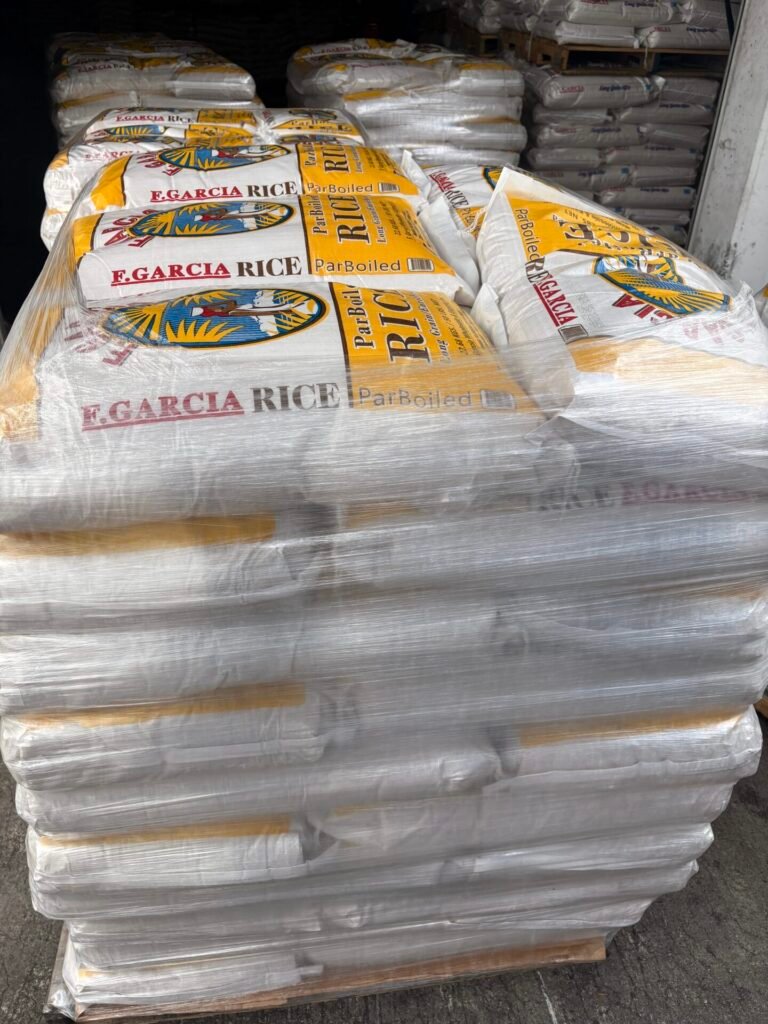
For current-crop rice pricing, supply positioning, and sourcing guidance, our team tracks each U.S. rice marketing year release as it lands. Contact the F. Garcia sales team to discuss how the transition into the 2026/27 marketing year affects your specific long-grain or parboiled rice sourcing needs — or browse our full rice supply options.
Frequently Asked Questions About the U.S. Rice Marketing Year
When does the U.S. rice marketing year start?
The U.S. rice marketing year runs August 1 through July 31 nationally. Individual states start earlier or later: Texas and Louisiana begin July 1, Arkansas and Mississippi begin August 1, Missouri begins September 1, and California begins October 1.
What is a ratoon crop?
A ratoon crop is a second, smaller rice harvest grown from the stubble of the first crop rather than replanted from seed. Producers in Texas and southwest Louisiana reflood fields after the main harvest, and the existing root system regrows and produces a second yield — only viable where the growing season is long enough for that regrowth to mature.
How often is the WASDE released?
The World Agricultural Supply and Demand Estimates (WASDE) report is released monthly, typically between the 8th and 12th of each month, and includes updated production, export, and ending-stocks figures for rice.
What is the CBOT Rough Rice futures contract?
CBOT Rough Rice futures (ticker ZR) trade in six contract months — January, March, May, July, September, and November. Each contract represents 2,000 hundredweight of U.S. No. 2 or better long-grain rough rice and is physically delivered from designated warehouses in eastern Arkansas.
Why do state marketing years differ from the national marketing year?
State marketing years are staggered to reflect actual regional harvest timing within the broader U.S. rice marketing year — Gulf Coast states harvest earliest and their marketing years start in July, while California’s medium/short-grain crop is harvested last and its U.S. rice marketing year doesn’t begin until October.
Related Guide: Sourcing beans as well as rice? See our Dry Edible Bean Marketing Year guide for the equivalent USDA reporting calendar on dry edible beans.
By Vitto Campuzano | Last updated September 11, 2026