Milling a bag of rough rice produces more than table-ready kernels. Every ton run through a rice mill yields four distinct rice co-products — hulls, bran, second heads, and brewers rice — each with its own composition, its own buyer, and its own market outside the food-grade kernel supply chain, plus screenings, the intermediate broken class USDA defines between the last two. For procurement teams sourcing milled rice, knowing what these rice co-products are (and aren’t) clarifies why a mill run separates the way it does, and why broken grades price differently than whole kernel.
⚡ Executive Summary: What a Mill Run Actually Produces
Rice co-products are not waste. Every lot of rough rice splits into streams that leave the mill on separate contracts, and USDA sets the dividing lines by sieve size rather than by eye.
- The Split: About 20% of rough rice mass is hull and another 10% is bran. What survives both milling passes is kernel — whole or broken.
- The Grade Line: A kernel retaining at least three-fourths of its length is “whole.” Anything shorter is “broken.” That single threshold in 7 CFR 868.302 creates every grade below head rice.
- The Broken Classes: USDA defines three — Second Head, Screenings, and Brewers Milled Rice — sized by the sieve or plate the fragments pass through, not by a fixed fraction.
- The Discount: Brokens are worth roughly 60% of head rice value. They carry the same starch and protein as whole kernel; size and end use set the price, not quality.
- What It Costs: Head rice yield prices the lot. At $0.20/lb head rice and $0.13/lb brokens, each percentage point of HRY is worth $0.07 per 100 lbs of rough rice; a 10-point drop costs about $0.32 per bushel.
- Where They Go: Hulls to bedding, fuel, filtration, and brewhouse lautering. Bran to livestock feed and rice bran oil. Brokens to rice flour, pet food, and commercial brewing.
Where Rice Co-Products Come From: Paddy to Kernel
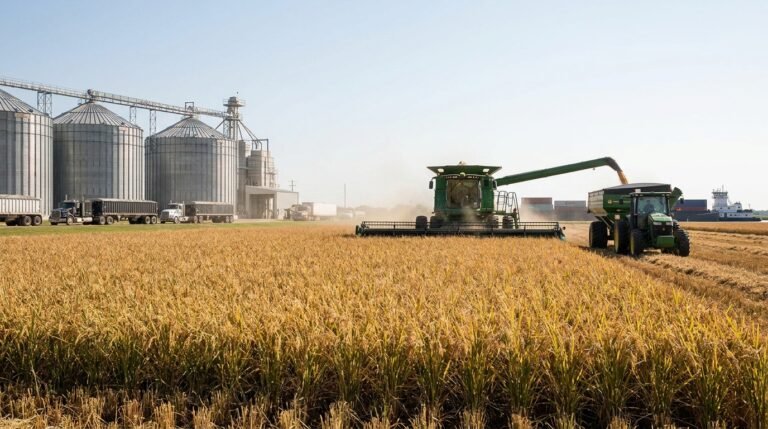
Rough rice (paddy) goes through two milling passes. The first, husking, strips the hard outer hull off the grain — a layer that represents about 20% of the rough rice kernel’s mass, per the University of Arkansas Division of Agriculture’s rice milling research. The second pass, whitening and polishing, removes the bran layer (roughly another 10% of the original mass) from the brown rice underneath, leaving the milled white kernel. Those two passes are where every one of the rice co-products below originates.
Not every kernel survives both passes intact. Under USDA’s U.S. Standards for Milled Rice (7 CFR Part 868), a “whole kernel” is an unbroken kernel or a broken kernel that retains at least three-fourths of its original length; anything shorter is a “broken kernel.” That single threshold is what separates a load of head rice from the second heads, screenings, and brewers rice graded out of it.
Rice Hulls
Hulls are the hard, woody outer shell removed during husking. They’re fiber and silica, not starch or protein, so they carry no meaningful nutritional value — which is why hulls are a byproduct rather than a feed ingredient in their own right. Of the four rice co-products, hulls have the least to do with food. Commercially, they go to livestock bedding, biomass fuel, industrial filtration, and brewing. In the brewhouse they work as a lautering aid: per The Oxford Companion to Beer, adding 1–5% of total grist weight in rice hulls to the mash improves wort runoff rate and wort clarity. Hulls don’t break down in the mash and contribute no flavor or color, which is what makes them useful in husk-light grain bills such as wheat and rye.
Rice Bran
Bran is the oily, powdery layer between the hull and the milled kernel, and it’s roughly 20% lipids by weight, per the same University of Arkansas milling research — the fat content that makes it valuable, and that makes unstabilized bran prone to rancidity within hours of milling. Unlike the other rice co-products, bran starts degrading the moment it leaves the mill. It’s also where the kernel’s B-vitamins concentrate before milling strips them away: USDA FoodData Central, SR Legacy, “Rice bran, crude” (FDC ID 169713) lists roughly 34 mg of niacin and 4 mg of vitamin B6 per 100 g, versus about 1.6 mg and 0.16 mg in raw, unenriched white rice — the bran layer runs more than 20 times richer in both. That’s why co-product suppliers typically sell both a raw and a heat-stabilized version: stabilization is what makes bran shelf-stable for feed and food use. Most bran output goes into livestock and poultry feed, with the remainder pressed for rice bran oil.
Second Heads, Screenings, and Brewers Rice: The Broken Grades
These are the rice co-products that come off the kernel stream itself rather than the outer layers. USDA’s milled rice standards (7 CFR 868.302) define three classes of broken kernels below head rice, graded by the sieve or plate size the fragments pass through rather than by eye: Second Head Milled Rice, Screenings Milled Rice, and Brewers Milled Rice — the smallest fragments, which don’t meet the kernel-size requirements for either of the other two classes. In practical terms, buyers commonly describe second heads as roughly ½ to ¾ the length of a whole kernel and brewers rice as smaller still — useful shorthand, though the regulatory standard itself is sieve-based, not a fixed fraction.
Nutritionally, all three broken grades carry the same starch and protein profile as whole kernel rice; only size, appearance, and price differ. Second heads are milled into rice flour and sold as budget table rice or a fermentation base for beverages. Brewers rice has a clean, consistent starch profile, which makes it a staple in commercial beer brewing and a common carbohydrate source in pet food formulations.
Head Rice Yield: Why the Split Sets the Price
The ratio between whole kernel and brokens is not just a sorting outcome — it is the number that prices the lot. Two yield figures do the work, both defined in the same University of Arkansas milling research:
- Milled rice yield (MRY) — total milled rice as a percentage of the original dried rough rice mass. Typical MRYs run 68% to 72%.
- Head rice yield (HRY) — head rice alone as a percentage of that same rough rice mass. HRY ranges from 0 (every kernel broken) to a theoretical maximum near 70%.
Milling quality is quoted as the ratio of the two. A 58/70 lot means an HRY of 58% against an MRY of 70% — 58% whole kernel, 12 points of brokens, and the remaining 30% of the original mass gone to hulls and bran.
Because brokens fetch roughly 60% of head rice value, every point of HRY carries real money. The University of Arkansas works the example directly: at $0.20/lb for head rice and $0.13/lb for brokens, each percentage point of HRY is worth $0.07 per 100 lbs of rough rice. An HRY falling from 60% to 50% takes $0.70 off every 100 lbs — about $0.32 per bushel.
Rice Co-Products at a Glance
| Co-Product | Description | Nutrition | Major Commercial Market |
|---|---|---|---|
| Hulls | Hard, woody outer shell | None (fiber/silica) | Bedding, fuel, brewing flow-aid |
| Bran | Oily, powdery inner layer | High (fats, B-vitamins) | Cooking oil, livestock supplements |
| Second Heads | Large broken rice pieces (~½–¾ kernel) | High (pure starch) | Rice flour, budget table rice, beverages |
| Screenings | Intermediate broken class between second heads and brewers | High (pure starch) | Rice flour, feed, fermentation |
| Brewers Rice | Small broken rice fragments | High (pure starch) | Pet food, commercial beer brewing |
FAQ
What are rice co-products?
Rice co-products are the streams a mill separates out alongside whole-kernel white rice: hulls, bran, second heads, screenings, and brewers rice. Everything except the hulls carries the same starch and protein as the whole kernel — the broken grades differ in size and price, not nutrition.
What does a 58/70 rice lot mean?
It is a milling quality quote: a head rice yield of 58% and a milled rice yield of 70%. In practice that lot delivers 58% whole kernel and 12% brokens, with the remaining 30% of the original rough rice mass removed as hulls and bran.
Is brewers rice the same as broken rice?
Brewers rice is one grade within the broken-rice category — the smallest fragments produced in milling, as defined by USDA’s Brewers Milled Rice class. Second heads are a larger broken grade. Both come off the same mill run but are sized, priced, and sold separately.
Are rice hulls edible?
No. Hulls are fiber and silica with no significant nutritional value, which is why they’re sold for bedding, fuel, and filtration rather than food or feed.
Why do brewers use rice hulls instead of rice bran?
Hulls are a physical filter aid — they add no flavor, color, or sugar. Bran is high in oil and would spoil a brew’s flavor and shelf stability if used the same way.
Does broken rice cost less than whole kernel rice?
Yes. Per University of Arkansas milling research, broken kernels are worth roughly 60% of the value of head rice — a discount that reflects size and end use, not nutritional quality, since second heads, screenings, and brewers rice all match whole kernel rice on protein and starch.
We supply and export whole-kernel long-grain and parboiled rice to foodservice distributors and export buyers. We do not carry the rice co-products above as a stocked line, but they come off the same mills we originate from — if you are sourcing bran, hulls, or broken grades, send us the spec and we will tell you straight whether we can quote it. The grade on your spec sheet is set by the same 7 CFR 868.302 standard that separates the brokens out. We’ve been shipping USDA-graded rice and beans out of Miami since 1974. See our full rice supply program or read more about how we source.
Sourcing Milled Rice?
Send us the grade, volume, and destination. We quote USDA-graded whole-kernel long-grain and parboiled rice for foodservice distributors and export buyers.